Russian
Scissor Lift Battery Recovery: Lead-Acid vs. Lithium – One Mistake = Battery Failure
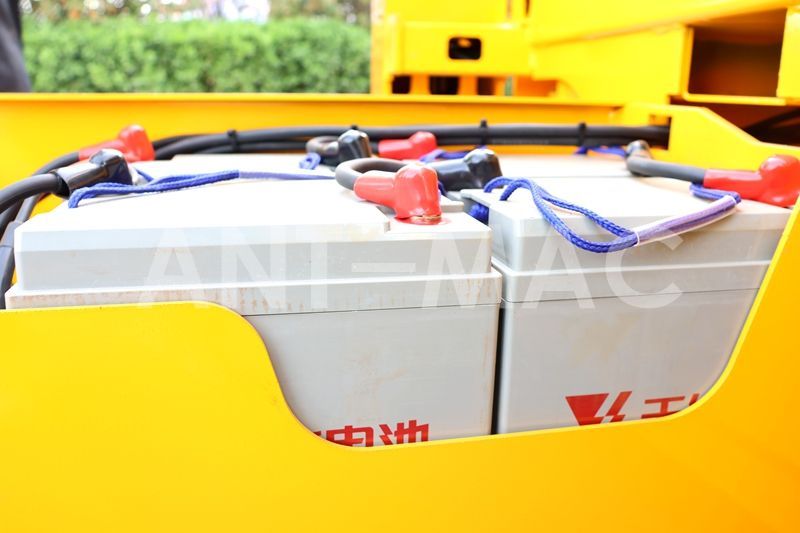
Midnight on site, your scissor lift stalls—battery dead! When time is tight, lead-acid and lithium batteries need totally different rescue tactics: Lead-acid survives a “jump-start,” but lithium (protected by BMS) could turn useless if you treat it like lead-acid. Master these 3-minute steps to save your battery and your schedule.
Lead-Acid Rescue: 3-Step Jump-Start (Tools Included)
Why it works: Lead-acid handles rough fixes, but sulfation risks grow with deep discharge.
Tools:
Same-voltage lead-acid battery (capacity ≥50% of the dead one)
Insulated jumper cables
Multimeter
Step 1: Disconnect All Loads
Shut off the major electricity change in the battery compartment first. This prevents voltage spikes from negative the lift’s electronics (controllers, motors).
Step 2: Connect Correctly (Polarity Matters!)
Red cable: Dead battery’s positive (+) → Donor battery’s positive (+)
Black cable: Dead battery’s negative (-) → Donor battery’s negative (-)
⚠️ WARNING: Reverse polarity = instant plate damage. Double-check connections!
Step 3: Start & Disconnect Fast
Start the lift, then remove jumpers immediately (keep connected ≤3 minutes). Let it idle for 15 minutes—deeply drained lead-acid needs slow charging to avoid sulfation.
Lithium (LiFePO4) Rescue: BMS Unlock (Never Use Lead-Acid Tricks!)
Why it’s different: Lithium’s BMS locks out power when voltage drops too low. Forcing a jump-start can fry the BMS.
Step 1: Check BMS Status
Use a multimeter to test cell voltage: If any LiFePO4 cell reads <2.5V, the BMS has activated protection.
Step 2: Wake It Up With a Lithium Charger
Connect a charger with “low-voltage wake-up” mode (standard chargers won’t work). Charge till all cells attain ≥3.0V—the BMS will release automatically.
Step 3: Reset (If Needed)
If the carry nevertheless won’t start, press the “reset button” (if available) in the battery compartment. Always put on insulated gloves and disconnect strength first!
2 Rules to Avoid Dead Batteries (Better Than Emergency Fixes)
Storage Charging:
Lead-acid: Store at 80% charge (≥15 days idle).
Lithium: Store at 50–60% charge (high voltage causes swelling).
Low-Charge Alerts:
Install a battery display to warn at 20% ultimate (lead-acid) or 30% final (lithium). Deep discharge completely damages lithium and speeds up lead-acid sulfation.
Lead-acid handles neglect but fears sulfation; lithium needs care but has BMS backup. When batteries die, the right move saves time and money. Save this guide—don’t let a dead battery kill your project!
 Ant Aerial Work Platforms Push
 Antmac 40m Truck Mounted Aeria
 Ant-Mac Aerial Work Platforms
 Global Aerial Work Platform Ma