Russian
Five Criteria for Selecting Reliable Aerial Work Platforms for Winter Operations in Russia
In the frigid temperatures of -20 °C, when most construction machinery has ceased operation due to its "blood" freezing, only a few aerial work platforms truly designed for extreme environments can still steadily extend their booms against the wind and snow, ensuring the continued progress of critical projects.
Russia's vast territory means long winters and extreme climates. In Siberia and the Far East, average winter temperatures can reach -15 °C to -25 °C, accompanied by strong winds, heavy snow, and complex permafrost terrain. In such conditions, ordinary aerial work platforms not only fail to start but are also prone to serious accidents due to material embrittlement and hydraulic failure. Therefore, selecting a truly reliable piece of equipment must adhere to the following five core criteria.
Standard 1: Extreme cold start-up and continuous operation capability of the core power system
In the Russian winter, the primary challenge facing equipment is freezing. A qualified aerial work platform's power unit must undergo rigorous extreme cold weather certification.
1. Low-temperature self-starting technology : The equipment needs to be equipped with a large-capacity low-temperature battery and integrate an intelligent preheating system , which can preheat the engine coolant, engine oil and even fuel lines to ensure that it can still start successfully with one button in an environment of -20℃ .
2. Cold-resistant dedicated powertrain : It should be equipped with a specially tuned turbocharged diesel engine, using high-grade antifreeze and engine oil adapted to ultra-low temperatures. For example, the vehicle platform provided by Antmac Heavy Industries for the Russian market features engines that have undergone "cold chamber" testing, maintaining the activity of core components at extremely low temperatures of -20 °C, ensuring an ignition success rate of over 99%.
Standard 2: Comprehensive freeze protection for hydraulic and electrical systems
Hydraulic oil solidification and electrical circuit failure are the main causes of equipment malfunctions in winter. Reliable equipment must have multiple layers of insulation barriers built for these "arteries" and "nerves".
1. Wide temperature range hydraulic system : It uses aviation-grade hydraulic oil with a low pour point (such as below -35 ℃), and wraps electric heating tape and insulation layer around key valve groups and pipelines . The temperature control system automatically starts and stops the system to maintain the fluidity of the oil.
2. Fully enclosed, moisture-proof electrical architecture : All wiring harnesses, connectors, and ECUs (electronic control units) must meet IP67 or higher protection standards , possessing moisture-proof and anti-icing capabilities. The control cabinet should be equipped with an automatic dehumidification and heating module to prevent short circuits caused by internal condensation.
Standard 3: Low-Temperature Toughness of Structural Materials and Key Components
Extreme cold can make ordinary steel brittle and cause seals to fail. The structure and mechanism of the equipment must be specially reinforced for low temperatures.
1. Special steel for cold weather : The core load-bearing structures such as booms and turntables should use special steel that can maintain high toughness at low temperatures (such as low-temperature steel that meets the Russian GOST standard) to avoid the risk of cold brittle fracture.
2. Low-temperature special sealing and lubrication : All hinge points and cylinder seals must be made of low-temperature resistant silicone or fluororubber materials and use wide-temperature-range grease to ensure flexible operation without jamming in extremely cold conditions.
Standard 4: Special design for operational safety and personnel comfort
In winter operations, safety and efficiency are equally important. Equipment design must fully consider operational safety and personnel protection in icy and snowy environments.
1. Comprehensive de-icing and snow prevention : The work platform must be equipped with anti-slip grates and heated pedals to prevent icing. The boom cable and camera should have automatic defrosting functions to ensure a clear field of vision.
2. Wind resistance and intelligent early warning : The equipment must have a higher wind resistance level (recommended ≥ level 12) and integrate tilt angle, wind speed and ice load sensing systems to automatically issue early warnings and restrict dangerous actions when the snow accumulation on the platform is too thick or the wind speed exceeds the standard.
3. Warm operating environment : The cab and upper control panel should have a powerful independent heating system, and a fully enclosed luxury control room with heating can be selected as an option to provide operators with a comfortable working environment.
Standard 5: High passability of the equipment chassis on ice, snow, and complex road surfaces.
Construction sites in Russia face complex road conditions in winter, potentially involving deep snow, ice, and uneven permafrost. Equipment chassis must possess excellent off-road and obstacle-avoidance capabilities.
1. All-wheel drive and all-steering off-road chassis : Preferred four-wheel drive or all-wheel drive chassis, equipped with off-road tires suitable for snow driving or optional rubber tracks. Multi-mode steering function (such as crab turn, stationary turn) allows for agile maneuvering in narrow snowdrifts.
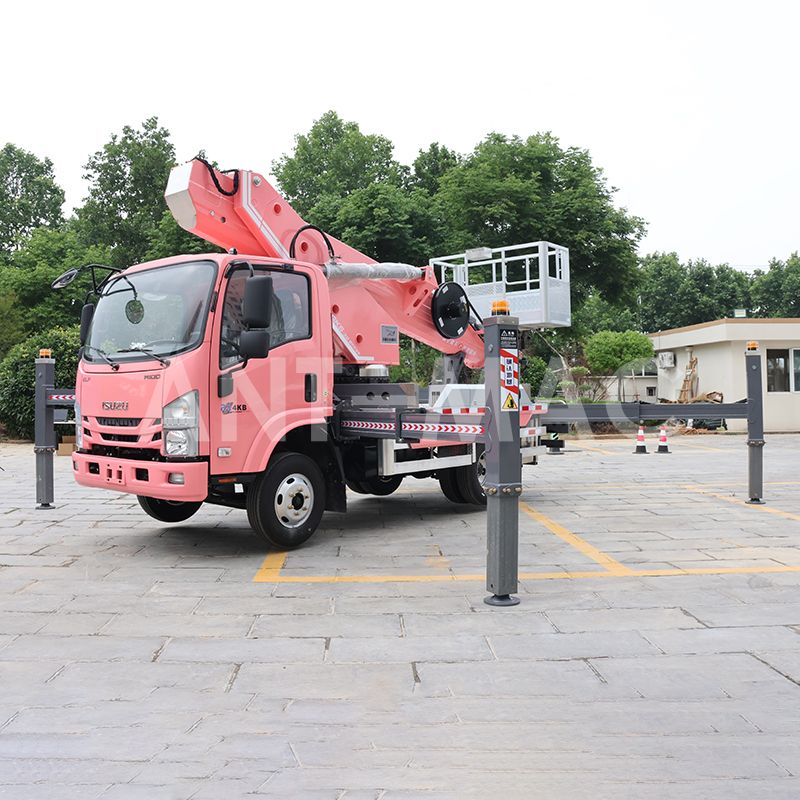
2. Professional outrigger leveling system : Large anti-slip pads should be installed under the outriggers to distribute the pressure on the frozen ground. The outrigger system must have a strong ability to level each leg independently , providing stable support for the equipment quickly, even on sloping, soft snow.
Why is Antmac the trusted choice for Russian winter sports?
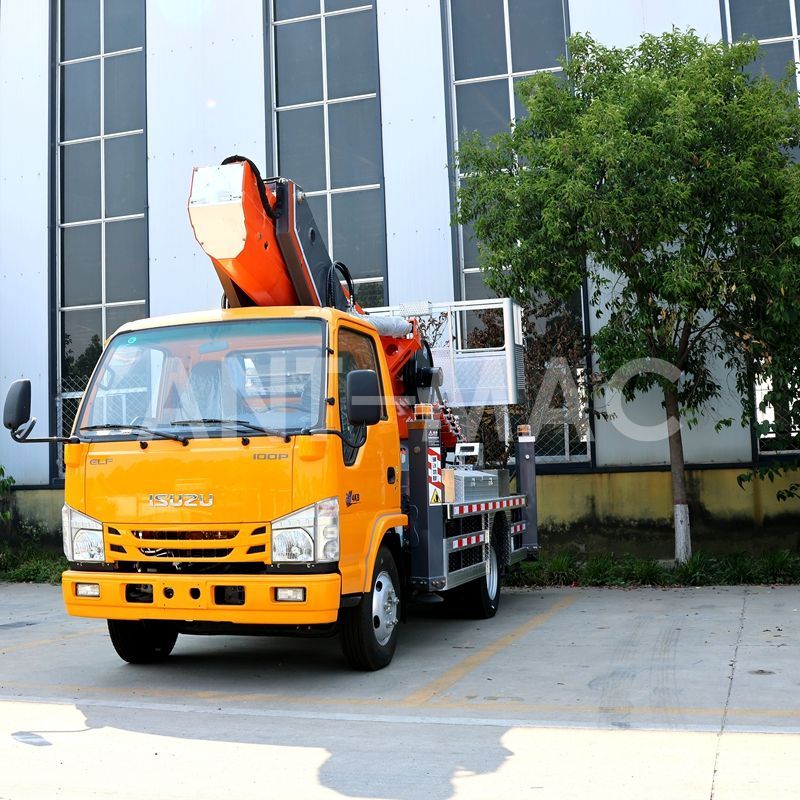
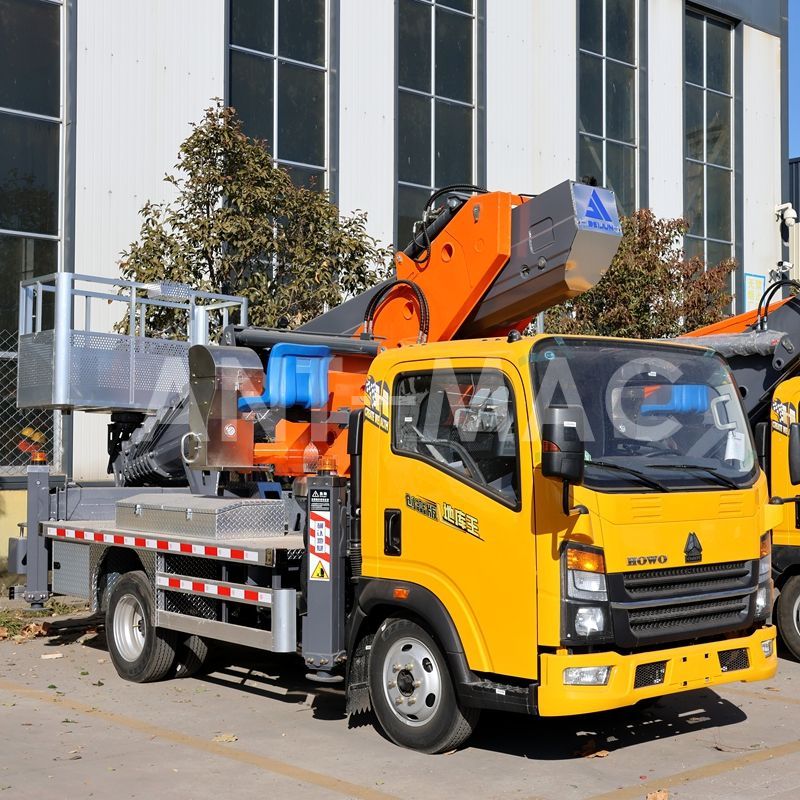
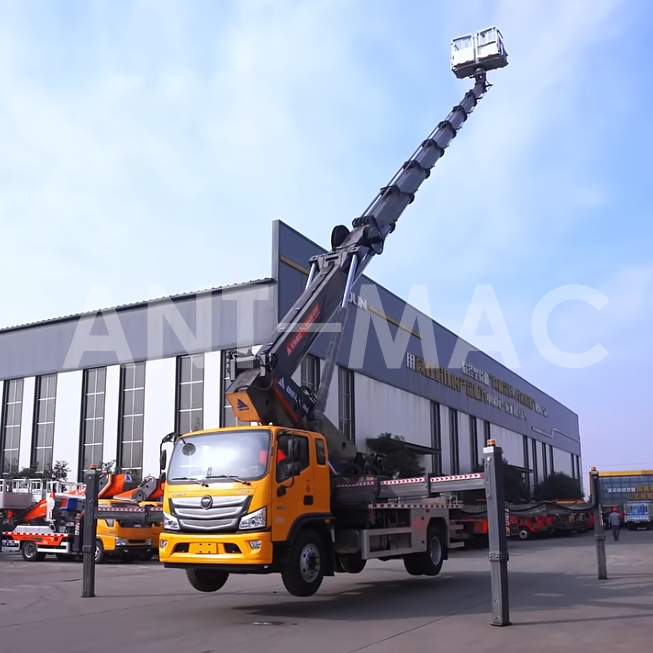
Originating from Shandong, China , Antmac 's truck-mounted aerial work platforms have become the preferred choice for many Chinese-invested and local energy, mining, and infrastructure companies in Russia, thanks to its deep understanding of extreme working conditions and robust product capabilities. This is not only because it strictly adheres to the five standards mentioned above, but also because it provides a complete "all-weather solution" :
1. Pre-verified cold-resistant package : All equipment shipped to Russia is equipped as standard with the aforementioned engine preheating, hydraulic heating, electrical protection and cryogenic materials. It undergoes rigorous testing in a -20 ° C environmental simulation chamber before leaving the factory , and its reliability has been pre-verified.
2. Localized service support : Antmac Heavy Industries has service outlets and spare parts warehouses in Russia, which can provide customers with rapid localized technical response, maintenance guidance and spare parts supply, solving their worries about winter maintenance.
3. Strong customization capabilities : As a manufacturer with more than 40 patents, Antmac can provide in-depth customization based on the specific needs of the project, such as enhanced heating systems and higher-level insulated cabs, perfectly adapting to the cold waves of Moscow to the extreme cold of the Yamal Peninsula.
Choosing an aerial work platform vehicle for winter operations in Russia is essentially choosing a partner capable of weathering harsh conditions. Antmac , with its unwavering commitment to reliability, is ensuring the smooth progress of countless critical projects in icy and snowy conditions, demonstrating the global adaptability of China's high-end equipment through its stable performance.
 Ant Aerial Work Platforms Push
 Antmac 40m Truck Mounted Aeria
 Ant-Mac Aerial Work Platforms
 Global Aerial Work Platform Ma